
Wall Street Journal Japan’s managing editor George Nishiyama invited as guest speaker at the inaugural seminar connecting media and public relations professionals in Japan
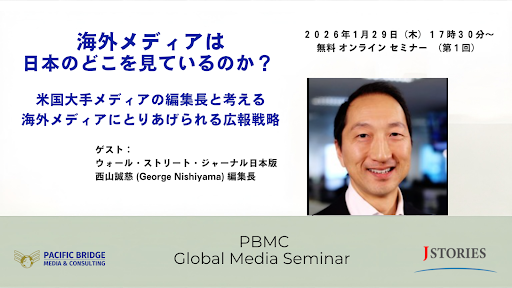
Pacific Bridge Media and Consulting, Inc. (PBMC) held its first session of a free online media seminar on January 29. With its aim to deepen understanding of the characteristics of international media while exploring ways for global media and corporate PR professionals to connect, the new seminar series will invite professionals working at the forefront of global media and news organizations.
The first guest speaker for the session was Mr. George Nishiyama, managing editor of The Wall Street Journal Japan.
Mr. Nishiyama currently oversees the Japanese-language content for the world’s major financial daily. Before his current role, he spent 16 years as an English-language reporter at Reuters’ Tokyo bureau, covering Japan from an international perspective distinct from that of domestic Japanese media.
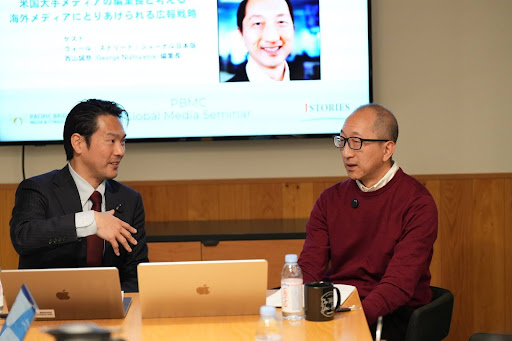
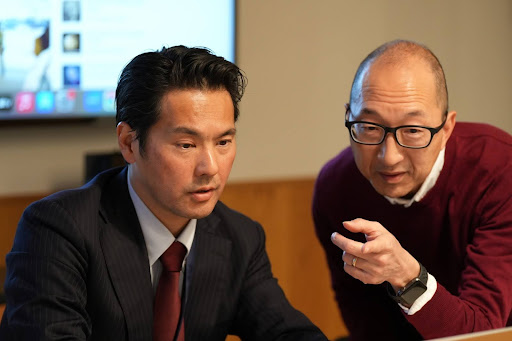
The seminar opened with an engaging discussion on the contrasting culture and structure between Japanese and international media, featuring Mr. Nishiyama and moderator Toshi Maeda, the executive editor of JStories and CEO of PBMC.
As information and service increasingly travel across borders in today’s world, cross-border communications have become essential for many business professionals and public relations professionals.
However, it is crucial to note that international and domestic media differ significantly despite both falling under the same broad category of “media” due to distinct cultural, historical, linguistic, and institutional frameworks. In particular, Mr. Nishiyama points out that when it comes to business news coverage, one of the major differences he perceives between Japanese and international media is the sense of distance between journalists and their subjects
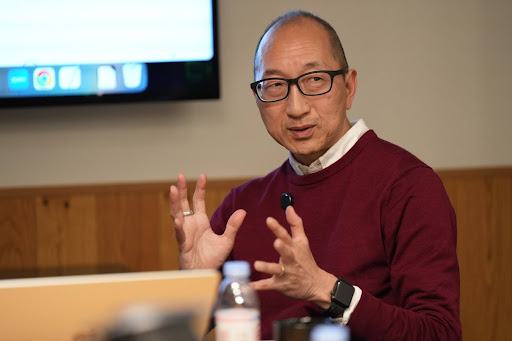
“Western journalists especially value keeping a clear ethical distance. They generally don’t form overly close relationships with corporate PR, and even when they’re pitched products or stories, they tend to approach the information with skepticism. That’s why it’s rare for PR materials to be published without significant independent verification,” says Mr. Nishiyama.
Moreover, the value of information originating in Japan differs between domestic and overseas audiences. Thus, in return, information must be adapted and modified to maximize the impact of that information abroad.
Mr. Nishiyama demonstrated how companies share information in ways that attract the interest of overseas media, citing recent articles from The Wall Street Journal. He explained that successful coverage depends on whether a story offers more than information already in circulation — revealing the behind-the-scenes process of creation and the human character of founders and engineers, rather than just facts.
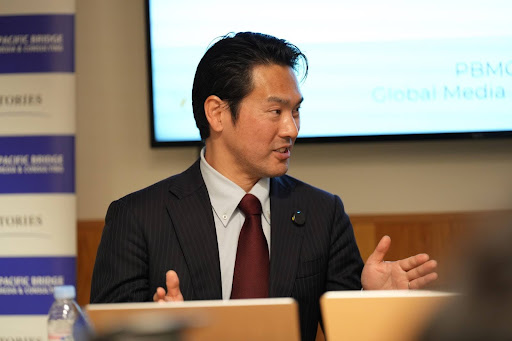
Meanwhile, moderator Maeda introduced several PR case studies in which PBMC supported Japanese companies in successfully securing coverage by overseas media. He highlighted examples where, in order to help foreign journalists understand uniquely Japanese businesses without relying on the Japanese language, PBMC helped film dynamic drone footage and provided the visuals directly to the media. By doing so, these companies were featured prominently as news stories by major international outlets.
Maeda emphasized that there are ways to naturally attract media interest by offering content that is designed from the perspective of overseas media and audiences — content that aligns with what they find genuinely compelling.
Mr. Nishiyama added that the most significant difference between Japanese and overseas media lies in their target readership. “In the case of The Wall Street Journal, the assumed audience is American business professionals,” he explained. “Even if company representatives passionately explain their business during an interview, if the topic does not align with what the publication’s readers care about, it may fail to generate interest and ultimately not lead to publication.”
When asked how The Wall Street Journal Japan decides which original English-language articles to translate for Japanese readers, Mr. Nishiyama responded, “Our mission is to deliver the real America.”
“Japanese media coverage of the U.S. reflects America as seen through the eyes of Japanese correspondents, he said. “To use a hamburger analogy, it’s like a burger tailored to Japanese tastes, rather than the kind served in an average American household. Our role is to offer something you can only experience in America. That said, we’re also careful not to focus so much on authenticity that the content becomes unpalatable to Japanese readers – maintaining that balance is always important.”
As the number of correspondents from major international media permanently based in Japan continues to decline year by year, the volume of Japan-originated news distributed globally is also decreasing. Against this backdrop, the importance — and rarity — of communicating first-hand information about Japan and Japanese companies in overseas standard languages, particularly English, is becoming ever greater.
Through this seminar series, PBMC will regularly invite journalists and media professionals who are active on the front lines of global media. By deepening understanding of the characteristics of overseas media — which may not be familiar to many — the seminars aim to explore points of connection between global media and domestic PR professionals.
The next session is scheduled for March. Corporate and government public relations professionals interested in participating are encouraged to contact us at info@pacificbridge.jp.